

Tour in Anhui
-

Anhui Province, also known as Wan for short, is located in southeast China, on the lower reaches of the Changjiang (Yangtze) River. The topography in Anhui Province is high in the southwest and low in the northeast. Mountains and hills make up two thirds of the total area. The climate belongs to semi-humid monsoon of warm temperate and subtropical humid monsoon.
Anhui Province has abundant tourist resources with beautiful landscape, many places of historic interest, and rich folk customs. The most famous scenic wonders include Mt.Huangshan, Mt.Jiuhua, Mt.Tianzhu, Mt.Langya, and Mt.Qiyun, all of which are national scenic spots. In 1990, UNESCO put Mt.Huangshan on the list of the World Cultural and Natural Heritages. In 2000, Xidi & Hongcun was listed in the World Cultural Heritages as well. Other tourist attractions are the Xin’an River, Taiping Lake, and the Water Park on Chaohu Lake etc.
Anhui Province is propitious for giving birth to great men, including Laozi, Zhuangzi, Guanzi, Cao Cao, Hua Tuo, Bao Zheng, Zhu Yuanzhang and Hu Shi. It has five state-level ancient cultural cities, including Shexian, Shouxian, Bozhou, Anqing and Jixi and six nature reserves. The long history has left behind a great number of historical sites, such as Xuguo Stone Arch and Tangyue archways in Shexian, the ancient residences in Yixian, and the opera theaters in Bozhou. Moreover, Anhui is famous for arts and crafts, four treasures of the study, iron pictures, and bronze wares.
Mount Huangshan
Mount Huangshan, formerly called Mt. Yishan in the Qin Dynasty (211-207 B .C.) is really a marvel: within an area of 154 square kilometers there is a crowd of peaks, 72 of which have names indicating the shapes they resemble. Lotus, Brightness Apex and Celestial Capital are the three major ones, all rising above 1,800 meters. The mountains are a body of granite, often with vertical joints. Erosion and fracture contributed to shape the rocks into huge columns, giving rise to lofty peaks and deep ravines. When it is cloudy the pinnacles loom in mists as if they were illusionary, while the sun is shining they unfold in all their majesty and splendour. The Yellow Mountains change their colour and appearance with the alternation of seasons. In spring blooming flowers decorate the slopes in a riot of colour and fill the valleys with fragrance; in summer you see verdured peaks rising one upon another and hear springs gurgling merrily. Autumn dresses the mountains in red and purple as maples are all blazing-red; winter turns them into a world of frost and ice with silver boughs and rocks everywhere.
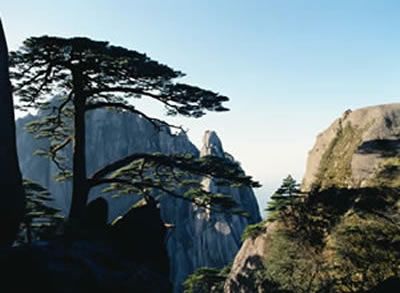
So from ancient times it has been frequented by tourists seeking their mystery and admiring their frequented by tourists seeking their mystery and admiring their scenery. They come to the conclusion that the fantastic pines, the grotesque rocks, the sea of clouds and the hot springs are the four major attractions of the Yellow Mountains. As a matter of fact there are marvels almost everywhere, especially in the following scenic areas: Wenquan (Hot Spring), Yupinglou (Jade Screen Tower), Xihai (West Sea), Beihai (North Sea), Yungusi (Cloud Valley Temple) and Songgu'an (Pine Valley Nunnery).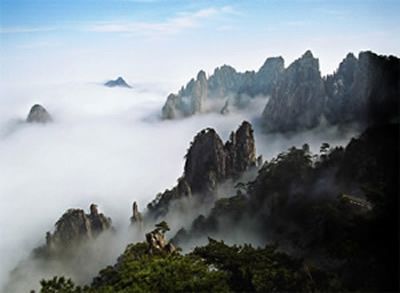
Hongcun Village
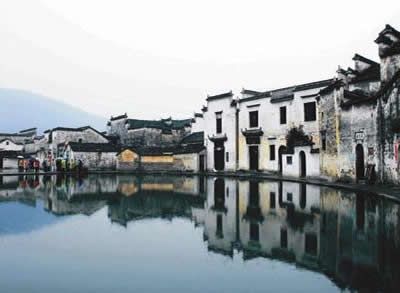
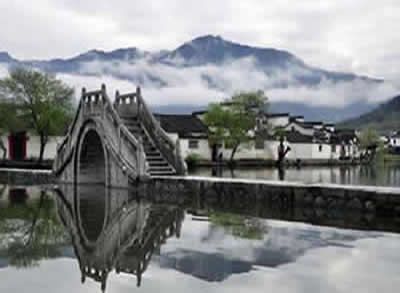
Hongcun Village is located at the foot of the southwest of Mt. Huangshan, only 11 kilometers away from Yixian town. It is a unique, buffalo-shaped ancient village, covering an area of about 30 hectares.
In the Song dynasty, about 900 years ago, the villagers constructed an irrigation canal intervening every house, so virtually every household in the village has easy access of the canal. The waterways of the village were supposed to be designed to provide source of washing water, even fire water in case of emergency. The construction was designed in similarity to a baffalo's body structure: Nanhu Lake is shaped like the baffalo's belly; Moon Pond looks like it's stomach; the channel its intestine. This vivid layout of buffalo is one outstanding feature of the village.
All the buildings follow local architectural style, have exquisite carvings and are magnificent symbols of its time. They were built with fine craftsmanship that is regarded as the best in China. Among them, Chenzhi Hall is a big and gorgeous residential building, including two living rooms, one Buddhism prayer section, one amusement room, etc. It enjoys the name of "Residence Museum".